
Table of Contents
Quick Answer: Is a Cold Press Juicer the Same as a Masticating Juicer?
Yes — “cold press” and “masticating” describe the same slow-juicing technology, not two different types of juicer. Both terms refer to a juicer that crushes and presses produce slowly (typically under 100 RPM) rather than shredding it at high speed. The real comparison worth making is slow (cold press/masticating) vs. centrifugal juicers — that’s where the actual differences in juice yield, heat, and noise come from.
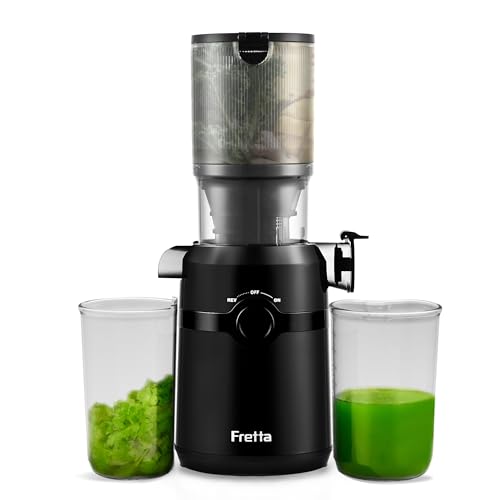
Check today’s price on Amazon: Fretta cold press juicer
Slow (Cold Press / Masticating) vs. Centrifugal: What Actually Differs
Centrifugal juicers shred produce with a fast-spinning blade and separate juice using centrifugal force — quick, but the speed introduces more heat and oxidation, and tends to produce a slightly lower juice yield from leafy greens. Slow juicers (cold press/masticating — the same thing) crush and press produce gradually, running quieter, extracting more juice from leafy greens and wheatgrass, and producing juice that separates less quickly in the fridge.
- Speed: Centrifugal juicers finish faster; slow juicers take longer per batch.
- Noise: Slow juicers run noticeably quieter — no high-speed blade.
- Leafy greens & wheatgrass: Slow juicers handle these far better; centrifugal juicers struggle.
- Juice separation: Slow-juiced juice tends to stay mixed longer in the fridge than centrifugal juice.
- Price: Slow juicers are typically more expensive than entry-level centrifugal models.
We cover this in more depth elsewhere on the site — the benefits of masticating (slow) juicers, why cold press juicers cost more, and how to clean one once you’ve bought it.
See the latest deal on Fretta cold press juicer
Black Friday & Cyber Monday 2026: Juicer Deals
Black Friday and Cyber Monday 2026 deals on juicers are coming — bookmark this page and check back from 27 November for live price drops.
FAQ
Is a cold press juicer the same as a masticating juicer?
Yes — they’re the same slow-juicing technology, just marketed under two different names.
What’s the real alternative to a masticating juicer?
A centrifugal juicer — the one that uses a fast-spinning blade instead of slow crushing/pressing.
Do slow juicers produce more juice than centrifugal juicers?
Generally yes, especially from leafy greens and wheatgrass, where centrifugal juicers struggle.
Are masticating juicers quieter than centrifugal juicers?
Yes — without a high-speed blade, slow juicers run noticeably quieter.
Why are masticating/cold press juicers more expensive?
The slower auger mechanism is more complex to engineer than a simple spinning blade, which is reflected in the price — see our full breakdown linked above.
Choosing Between Slow Juicers
Because cold press and masticating are the same technology, the practical differences between models come down to feed chute size, screw design, ease of cleaning and warranty. A Fretta cold press juicer is a typical self-feeding cold press model with a wide chute.
View on Amazon UK: Fretta cold press juicer
Slow juicers run quietly and produce drier pulp than centrifugal juicers, but they take longer per glass and cost more. If you juice leafy greens or wheatgrass, a slow juicer extracts more than a fast one. If you juice occasionally, a cheaper centrifugal model may be enough.
Electricity cost of 30 minutes at the listed motor power, at the Ofgem price cap unit rate of 26.32p/kWh (1 Oct–31 Dec 2026, GB average, direct debit). Wattages are taken from the Amazon UK listing titles and are maximum ratings, so real use is usually lower.
These are upper-bound figures for slow juicers: running costs are small, so choose on capability and durability rather than electricity.
Compare prices on Amazon: Fretta cold press juicer
What to Check Before You Buy a Juicer
Feed chute width decides how much chopping you do, and the number of parts decides how long cleaning takes. Look at the juicing screw material, the pulp-ejection design and whether the parts are dishwasher safe. A Fretta cold press juicer shows the typical layout of a self-feeding slow juicer.
FAQ
Is a cold press juicer worth it?
If you juice often and care about yield, noise and nutrient retention claims, a slow juicer suits you better. Occasional juicers may prefer a cheaper centrifugal model.
Are slow juicers hard to clean?
Most have fewer, larger parts than they used to, and many are dishwasher safe. Rinse them straight after use before pulp dries.
Do slow juicers use a lot of electricity?
No. Listed motor power is typically 150 to 300 watts, so a typical juicing session costs a few pence at the Ofgem cap.
Black Friday and Cyber Monday 2026 deals on juicers are coming — bookmark this page and check back from 27 November for live price drops.
Check today’s price on Amazon: Fretta cold press juicer
Similar Posts:

Tina has ten years of testing and reviewing kitchen gadgets. I am a home-trained chef. I like to make cakes, pastries, biscuits, icing, and all kinds of home baking/cooking. As someone who likes trying out new kitchen gadgets to up my cooking skills. Over the past ten years, I often find myself buying gadgets like mini choppers, blenders, cookers, frying pans, kettles, and all kinds of kitchen appliances. Getting value for your money whenever you purchase an item requires adequate research and testing. So I decided to collate most of the information I have gathered over ten years of using and researching different kitchen gadgets into coxonskitchen.co.uk.